
How to Identify Early Signs of Autism in Toddlers (1–3 Years): An Ayurveda-Informed Guide
Recognizing autism in toddlers early can make a real difference. Here’s what parents should watch for between ages 1 and 3 — along with how Ayurveda views developmental balance as a complementary support alongside medical care.
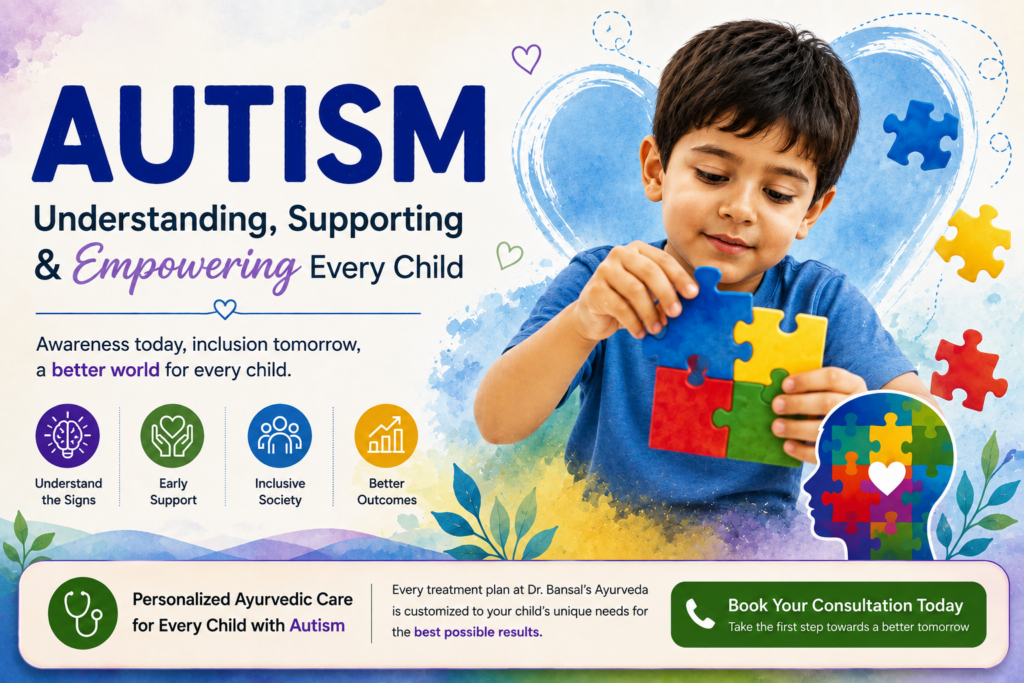
Why Early Identification Matters
The toddler years — roughly ages 1 to 3 — are when the brain develops fastest. This is also the window in which the earliest, most reliable signs of autism spectrum disorder (ASD) tend to appear. Spotting autism in toddlers early doesn’t just aid diagnosis; it opens the door to timely therapy, family support, and — for parents interested in holistic wellbeing — Ayurvedic lifestyle practices that can complement conventional developmental care.
Autism is a neurodevelopmental condition, not an illness to be “cured,” and no single sign confirms it. A cluster of consistent patterns, observed over weeks and months, is worth discussing with a pediatrician.
Early Signs of Autism in Toddlers by Milestone
Reduced Eye Contact and Social Engagement
Typically developing toddlers make eye contact, smile back, and enjoy peekaboo-style games. A toddler showing early signs of autism may avoid eye contact, seem uninterested in faces, or not respond consistently when someone calls their name by 12 months.
Delayed or Unusual Speech Development
Watch for:
- No single words by 16 months
- No two-word meaningful phrases by 24 months
- Loss of previously acquired words or babbling (regression)
- Repeating words or phrases (echolalia) without apparent communicative intent
Limited Gestures and Joint Attention
By 12–14 months, most toddlers point at objects to share interest, wave goodbye, or bring toys to show a parent. A toddler on the autism spectrum may not point, may not follow another person’s gaze, or may seem to “look through” people rather than engaging with them.
Repetitive Behaviors and Restricted Interests
Hand-flapping, spinning, lining up toys instead of playing imaginatively, or becoming intensely fixated on a narrow interest (like wheels or lights) can be early markers worth noting — especially when combined with other signs above.
Sensory Sensitivities
Unusual reactions to sound, light, texture, or touch — such as extreme distress at loud noises, aversion to certain fabrics, or seeking intense sensory input like spinning — are common in toddlers with autism.
Difficulty with Transitions and Routine
A strong need for sameness, meltdowns over small changes in routine, or difficulty adapting to new environments can also signal underlying developmental differences.
If several of these patterns appear together and persist, an evaluation by a pediatrician, developmental pediatrician, or child psychologist is the appropriate next step. Pediatricians commonly use standardized screening tools like the M-CHAT-R around 18 and 24 months.
The Ayurveda Perspective on Child Development
Ayurveda, India’s traditional system of medicine, views a child’s growth through the lens of Tridosha (Vata, Pitta, Kapha) balance and the health of the nervous system (Majja Dhatu) and mind (Manas). While Ayurveda does not diagnose or replace clinical diagnosis, practitioners often describe supportive approaches aimed at calming an aggravated Vata dosha — linked to movement, communication, and the nervous system, and often considered imbalanced in children with sensory sensitivity, restlessness, or speech delay.
Commonly discussed Ayurvedic support measures
- Abhyanga (gentle oil massage): Practitioners traditionally use warm sesame or Ayurvedic herbal oils, applied through rhythmic massage, to soothe the nervous system and improve body awareness and sensory regulation.
- Nasya (nasal administration): Under professional guidance, practitioners sometimes use mild herbal nasal drops to support cognitive and neurological function — only a qualified Ayurvedic pediatric practitioner should administer this.
- Dietary balance (Ahara): Ayurveda emphasizes warm, easily digestible, Vata-pacifying foods, consistent meal routines, and avoiding excess processed or cold foods to support gut-brain health, an area of growing scientific interest in autism research.
- Daily routine (Dinacharya): Predictable sleep, meal, and play schedules align with Ayurvedic principles and also happen to support toddlers on the spectrum, who often thrive with structure.
- Herbal support: Practitioners traditionally reference herbs like Brahmi, Shankhpushpi, and Ashwagandha for cognitive and nervous system support, but parents should never give them to a toddler without consulting a qualified Ayurvedic doctor, given limited pediatric safety data.
Important note: Parents should view Ayurvedic approaches as complementary, not a substitute for evidence-based interventions such as speech therapy, occupational therapy, and behavioral therapy (like ABA), which remain the gold standard for supporting toddlers with autism. Always consult both a pediatrician and a qualified Ayurvedic practitioner before starting any herbal or therapeutic protocol for a young child.
When to Seek Professional Help
Trust parental instinct. If your toddler shows a consistent pattern of the signs above — not just an occasional off day — schedule a developmental screening. Early intervention between ages 1 and 3, when the brain is most adaptable, strongly correlates with better long-term outcomes.
Final Thoughts
Identifying autism in toddlers early empowers parents to seek timely support — combining conventional developmental therapies with time-tested Ayurvedic practices focused on nervous system balance, routine, and holistic wellbeing. The goal isn’t a label, but a supportive path forward for every child to thrive.
Frequently Asked Questions
- At what age can early signs of autism in toddlers be noticed?
Some signs, like reduced eye contact or limited response to name, can appear as early as 12 months. Most reliable screening happens between 18 and 24 months, though every child develops at a different pace.
- Is speech delay always a sign of autism?
No. Speech delay alone can stem from many causes, including hearing issues or simply individual pace of development. It becomes more significant as a sign of autism when it appears alongside reduced eye contact, limited gestures, or repetitive behaviors.
- Can autism be diagnosed at 18 months?
Yes, autism can be reliably identified by trained specialists as early as 18 months using tools like the M-CHAT-R screening questionnaire, followed by a full developmental evaluation.
- Does Ayurveda cure autism?
No. Ayurveda does not cure autism. It offers complementary practices — such as oil massage, herbal support, and routine-based care — that may support the nervous system and overall wellbeing alongside conventional therapies like speech and occupational therapy.
- Is Abhyanga (oil massage) safe for toddlers with autism?
Gentle, warm oil massage is generally considered safe and calming for many toddlers, but it should be introduced gradually and guided by a qualified Ayurvedic practitioner, especially if the child has sensory sensitivities to touch.
- Should I wait and watch, or seek help immediately if I notice signs?
If you notice a consistent pattern of signs — not a single instance — it’s best to consult a pediatrician promptly. Early intervention during the toddler years leads to significantly better developmental outcomes.
- Can diet really make a difference for toddlers with autism?
Ayurveda emphasizes warm, easily digestible, Vata-balancing foods and consistent meal routines to support gut and nervous system health. While not a treatment on its own, a balanced diet is a helpful complementary measure alongside professional therapy.
Disclaimer: This article is for informational purposes only and is not a substitute for professional medical or developmental diagnosis. Please consult a qualified pediatrician, developmental specialist, and Ayurvedic doctor before making any healthcare decisions for your child.